

SCHOOL
Snowpark Basics
1/4 What is a snowpark?
Snowparks are specially prepared areas within a ski resort. They offer obstacles made of snow or artificial materials that are suitable for performing tricks.
Skiers and snowboarders in snowparks are called riders. Obstacles are also known as features. A ride through the park over the obstacles is called a run, while a longer stay in the park with mutiple runs is referred to as a session.
2/4 Which obstacles can you find in snowparks?

KICKER

Transition
Landing
Table
In-run
Take-off
Kickers (also called jumps) are snow-built ramps. They are designed to provide controlled airtime, allowing riders to perform tricks while in the air.
The side profile of a kicker can be divided into different sections:
The in-run is the area before the kicker where you approach the jump. The transition starts where the kicker begins to rise and leads up to the take-off. The section between take-off and landing is called the table, which you usually clear when jumping. The sloped surface after the table, where you land, is called the landing.
There are different types of kickers that vary in shape and size:
Tabletop

A kicker where the take-off and landing are connected by a flat table that you can safely land on.
Step Down

A kicker where the take-off is higher than the landing area.
Roller

A kicker with a smooth landing shaped to match the flight path, allowing for a fluid landing.
Step Up

A kicker where the take-off is lower than the landing area.
Corner

A kicker where the transition meets the landing area at a right angle.
Drop

A kicker without a classic transition, where the take-off happens from a kind of step that you “drop” off.

JIBS
Jibs are man-made obstacles made of steel, plastic, or wood that are fixed into the snow.
When riding these obstacles, you slide or ride over them and may perform additional tricks. Depending on the obstacle, this is referred to as jibbing, sliding, bonking, or tapping.
There are different types of jibs:


Rails & Tubes
Rails are narrow, usually round and sometimes square tubes with a relatively small diameter. They can be straight, curved (rainbow), kinked (stepped), curved in shape, angled upward (up), or angled downward (down)..
Tubes are a variation of rails, consisting of round, hollow pipes that often have a larger diameter.
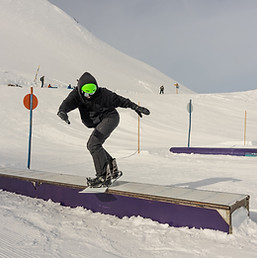
Boxes
Boxes are flat platforms that can range from narrow to wide. They can be straight, curved (C), or wave-shaped (W).
Variations of boxes include features designed like benches or tables, with a box surface used for sliding (park bench or picnic table).

Wallrides
Wallrides are steep, almost vertical walls.
They’re less about taking off and more about riding up or along them sideways.

Bonks
Bonks are small features that are round, cylindrical, or cone-shaped, usually with a small kicker in front of them.
The goal for riders isn't rider over them, but to tap, lightly touch, or bounce off them while jumping over (bonking/tapping).
Common bonks include balls (a sphere on the ground), lollipops (a sphere on a pole), and barrels (a cylindrical drum).

HALFPIPES
Halfpipes are U-shaped snow structures built into a slope. The opposing walls on either side are steeply inclined.
Riders go back and forth between the walls, launching above the edges to perform tricks.
Especially large halfpipes are called superpipes.

WHERE?
Halfpipes are currently only available in a few snowparks in Europe. On Snowplayground, all parks with a (temporary) halfpipe are marked with the symbol H .
3/4 How is a snowpark built and how is it maintained?
Planning
Planning a snowpark starts even before the first snowfall. When choosing a location, the existing terrain of the ski resort is taken into account. Factors like slope gradient, sun exposure, and wind conditions play an important role, as they directly affect snow quality, safety, and rideability. Having a nearby or dedicated lift also makes the park easier to access.
Once a suitable location is found, the park layout is designed. This includes creating lines tailored to different skill levels, from beginners to pros. The placement of obstacles follows the natural terrain profile: larger features like kickers or halfpipes require more space and may involve reshaping the terrain even before snowfall - for example, by building mounds for kickers or digging out areas for halfpipes. Smaller features like rails or boxes can be positioned more flexibly.


Construction
Once there is enough snow, the actual build begins. Snow groomers spread both natural and artificial snow and roughly shape the kickers. Jibs are placed in their designated spots and secured in the snow. So-called shapers (park builders) then shape the take-off area of each obstacle by hand using tools like shovels and rakes. They precisely adjust the take-off angle, remove ice chunks, and add snow where needed.
Maintenance
During the regular winter season, all obstacles in a snowpark are checked daily by the shapers and reshaped as needed. Take-offs and landings are often heavily used and worn out after just one day. The park also needs to be reshaped after fresh snowfall or after contests, when the obstacles see a lot of use.

4/4 What rules are there in snowparks?

-
Pay attention to snow and weather conditions, which can change throughout the day.
-
Warm up and prepare yourself before starting a session.
-
Asses your own skill level correctly, take a close look at the obstacles before your run, and always progress gradually.
-
Give other riders a signal - if necessary - when you are starting your run.
-
Keep a sufficient distance from riders in front of and next to you.
-
Obstacles, as well as the approach and landing areas, must be kept clear and vacated promptly after a run.
-
Take-offs from obstacles are intended for riding the obsctales, not for side jumps.
-
If someone gets injured, provide first aid and, if necessary, close off the obstacle.
-
Be friendly and helpful, and share your experiences with others.

